VAT7 min read
VAT responsibilities: what changes when you register
Registration affects your pricing, your paperwork and your quarterly routine. A plain guide to the threshold, the schemes and the obligations that follow.
VAT is the tax that changes the most about how a business runs day to day. It affects what you charge, what you can reclaim, how you keep records and what you have to submit every quarter. Understanding it before you reach the threshold is far more comfortable than working it out afterwards.
When registration becomes compulsory
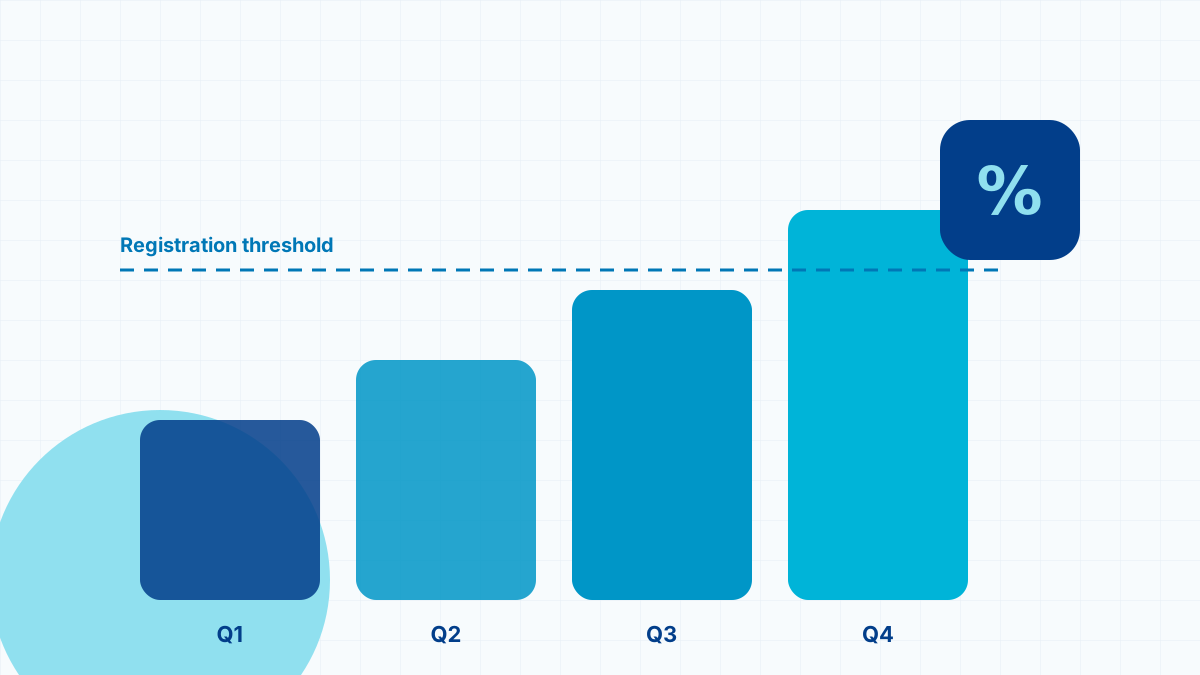
Registration is required once your taxable turnover over any rolling twelve-month period passes the registration threshold. Two points catch people out. The first is that the test is a rolling one, so it is not tied to your accounting year. The second is a forward-looking test: if you expect to pass the threshold within the next thirty days alone, you must register straight away.
You can also register voluntarily below the threshold. That can make sense if your customers are VAT-registered businesses and you incur significant VAT on your own purchases. It rarely makes sense if you sell mainly to the public, because you would be adding VAT to prices your customers cannot reclaim.
What changes once you are registered
- You charge VAT on your standard-rated sales and issue invoices that meet HMRC requirements.
- You can generally reclaim VAT on business purchases, subject to the usual restrictions.
- You keep digital records and file returns using compatible software.
- You submit a return, usually quarterly, and pay any VAT due by the deadline for that period.
- You review your pricing, because your effective margin changes if you cannot pass the VAT on.
Choosing a scheme
Several schemes exist to simplify VAT for smaller businesses, and the right one depends on your margins, your costs and your cash flow.
- Standard accounting: you account for VAT on invoices issued and received, whether or not they have been paid.
- Cash accounting: you account for VAT when money actually changes hands, which helps if customers pay slowly.
- Annual accounting: you make instalment payments and submit one return a year, which smooths the admin but not the underlying liability.
- Flat rate scheme: you pay a fixed percentage of gross turnover and generally cannot reclaim VAT on purchases, which suits some low-cost service businesses and penalises others.
Eligibility for each scheme has its own turnover limits and conditions. It is worth modelling the options against your actual figures before choosing, because the difference between schemes over a year can be significant.
Making Tax Digital in practice
VAT-registered businesses must keep digital records and file returns through compatible software. In practice this means your bookkeeping needs to be maintained continuously rather than reconstructed at the end of each quarter. That is a change of habit more than a change of system, and most people find the quarterly routine easier once the records are kept up to date week by week.
Common mistakes
- 1Missing the registration date because turnover was measured against the accounting year instead of a rolling twelve months.
- 2Reclaiming VAT on costs that are blocked or partly personal, such as entertaining or a vehicle used privately.
- 3Treating every sale as standard-rated when zero-rated or exempt treatment applies, or the reverse.
- 4Forgetting that VAT collected is not the business’s money, and spending it before the payment date.
- 5Overlooking VAT on services bought from suppliers outside the UK, which can create an obligation to account for the tax yourself.
If you are approaching the threshold, the useful time to have the conversation is a few months before you reach it, while you still have room to plan pricing and set up your records properly.